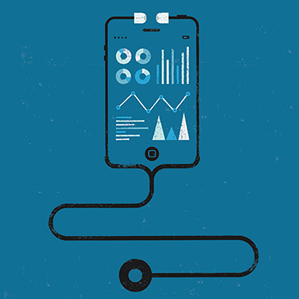
Medical data is a hot spot for venture investing and product innovation. The payoff could be better care.
After decades as a technological laggard, medicine has entered its
data age. Mobile technologies, sensors, genome sequencing, and advances
in analytic software now make it possible to capture vast amounts of
information about our individual makeup and the environment around us.
The sum of this information could transform medicine, turning a field
aimed at treating the average patient into one that’s customized to each
person while shifting more control and responsibility from doctors to
patients.
The question is: can big data make health care better?
“There is a lot of data being gathered. That’s not enough,” says Ed
Martin, interim director of the Information Services Unit at the
University of California San Francisco School of Medicine. “It’s really
about coming up with applications that make data actionable.”
 The business opportunity in making sense of that data—potentially
$300 billion to $450 billion a year, according to consultants McKinsey
& Company—is driving well-established companies like Apple,
Qualcomm, and IBM to invest in technologies from data-capturing
smartphone apps to billion-dollar analytical systems. It’s feeding the
rising enthusiasm for startups as well. Venture capital firms like
Greylock Partners and Kleiner Perkins Caufield & Byers, as well as
the corporate venture funds of Google, Samsung, Merck, and others, have
invested more than $3 billion in health-care information technology
since the beginning of 2013—a rapid acceleration from previous years,
according to data from Mercom Capital Group.
The business opportunity in making sense of that data—potentially
$300 billion to $450 billion a year, according to consultants McKinsey
& Company—is driving well-established companies like Apple,
Qualcomm, and IBM to invest in technologies from data-capturing
smartphone apps to billion-dollar analytical systems. It’s feeding the
rising enthusiasm for startups as well. Venture capital firms like
Greylock Partners and Kleiner Perkins Caufield & Byers, as well as
the corporate venture funds of Google, Samsung, Merck, and others, have
invested more than $3 billion in health-care information technology
since the beginning of 2013—a rapid acceleration from previous years,
according to data from Mercom Capital Group.
100,000: Number of health apps available for smartphones
This MIT Technology Review Business Report looks at the
technologies and companies most likely to survive the boom and the
challenges they will face as they push to remake health care.

The groups that control the most medical data today are insurance
companies and care providers, and their data analysis is already
beginning to change health care. Express Scripts, which manages pharmacy
benefits for 90 million members in the U.S. and processes 1.4 billion
prescriptions a year, has scoured its data from doctors’ offices,
pharmacies, and laboratories to detect patterns that might alert doctors
to potential adverse drug interactions and other prescription issues.
Doctors can now know 12 months in advance, with an accuracy rate of 98
percent, which of their patients may fail to take their medicine. Taking
steps to avert that problem could improve patients’ health and reduce
the $317 billion spent in the United States each year on unnecessary ER
visits and other treatment.
Today many companies and health-care providers are adding other
layers of information to create an increasingly precise,
patient-specific brand of medicine. New mobile technologies, for
example, could provide information about a patient’s everyday behaviors
and health, creating opportunities for care providers to influence
patients far more frequently. Data brought in from electronic health
records would add doctors’ insights, test results, and medical history.
Genetic data would offer insight into whether patients are predisposed
to certain conditions or how they might react to treatments.
“We want to believe that most of the things we do in
medicine are based on evidence,” says Malay Gandhi, managing director of
Rock Health, which funds health-care startups. “Some are, but most
aren’t.” The opportunity, he says, is that medicine could become more
analytical and evidence-based.
Data is also changing the role of patients, offering them a chance to
play a more central part in their own care. One way is by using mobile
technology to monitor sleep patterns, heart rate, activity levels, and
so on. In development are even more advanced devices capable of
continuously monitoring such key metrics as blood oxygen, glucose
levels, and even stress. And companies like Apple are hoping to become
repositories for all this information, giving consumers new ways to
track and perhaps improve their health.
This kind of information may be useful and interesting for anyone,
but it can become essential for the millions living with chronic
conditions like diabetes, heart disease, and depression. WellDoc makes a
prescription-only FDA-approved “patient coaching” system, which advises
users on how much insulin they should take in light of information
recorded on their smartphones: blood sugar levels, recent meals, and
exercise. It also offers tailored messages of encouragement and provides
the patient’s doctor with treatment recommendations based on their data
and established medical guidelines. A feature under development would
enable the system to predict a hypoglycemic reaction and help users
avoid it.
Ginger.io uses data collected (with permission) from a phone and
other sensors to assess the behavior of people with mental illnesses
such as depression. Are they calling loved ones, or getting enough
sleep? When a patient is showing signs of struggling, someone can be
alerted.
Over time, both companies will aggregate this information to help
doctors study and improve treatment overall. “It’s like one of the
largest clinical trials in history,” says Chris Bergstrom, WellDoc’s
chief strategy and commercial officer. “And it’s not even in an
artificial environment—it’s in real time.”
Families affected by Phelan-McDermid syndrome, a rare condition in
which a deletion on chromosome 22 causes problems such as learning and
memory deficits, are building a database of information from genomic
tests, clinical medical records, extensive family surveys and histories,
and more. The goal is to create a central repository where researchers
can examine multiple sources of data simultaneously. That’s increasingly
important as researchers begin to see connections between
Phelan-McDermid, autism, and other conditions. Another benefit: data
that once would have been locked up in one academic researcher’s lab
will now be readily available to many different experts.
“So much of that data is already out there,” says Megan O’Boyle,
whose daughter Shannon was diagnosed in 2001, just two years after
chromosome 22 was sequenced. “It’s just sitting there waiting to be
used.”
Conclusion: Technology has always helped in the development of Science and Medicine, This change can change a lot of things...
 Infosys' incoming chief executive officer Vishal Sikka signaled the coming technology led changes at Infosys but said that no major transformation is imminent at India's second-largest software company.